
Why BRICS+ Needs Sovereign Data Corridors in 2026
The need for BRICS+ to design “trusted data corridors” stems from a fundamental shift in how data is viewed in the 21st century: not just as a flow of information, but as a strategic asset, a source of sovereignty, and a foundation for economic and political power. In this context, cross‑border data flows can no longer be treated as a purely technical matter; they reshape who controls digital infrastructure, who sets standards, and who captures value from analytics and artificial intelligence.
Large Western companies (e.g., Google, Amazon, Meta, Microsoft) are influencing the present state of the world’s digital infrastructure and data governance models, which are in line with US/EU regulatory frameworks (e.g., GDPR, CLOUD Act). As tools of global power and influence, the BRICS+ nations want to reduce their reliance on these systems. BRICS+ wants to create a third pole—a structured, interoperable alternative to the US-led and EU-led models, preventing their own fragmentation while offering a cohesive platform for the Global South.
What Risks BRICS+ May Face When Designing Trusted Data Corridors
While the strategic intent behind BRICS+ trusted data corridors is clear, the path is fraught with significant, multi-layered risks, especially the potential weakening of national sovereignty.
Members have very different privacy, cybersecurity, and surveillance regimes, making it hard to define a common “adequate protection” baseline for data flows. Countries such as Brazil and India, who promote data localization for their cultural and economic interests, may resist such harmonization, thereby weakening the initiative’s actual practicality.
On the other hand, if corridor rules or common technical standards effectively override national data protection or cybersecurity laws, states may lose the ability to decide how data about their citizens and firms is processed. In practice, this can hollow out sovereignty: formally, domestic rules remain in place, but in the most data-intensive sectors, operators follow corridor or platform standards that are harder for national regulators to shape or contest. Over time, real power moves from parliaments and supervisory bodies to technical committees, foreign cloud providers, and transnational dispute resolution procedures that may not be in line with local needs or constitutional limits.
How Can BRICS+ Design Trusted Data Corridors Without Challenging Members Data Sovereignty?
To avoid potential risks, BRICS+ must adopt a dual strategy: create a protective “fortress” of sovereign capabilities and build infrastructures that respect national authorities.
1. Establishing a Digital Sovereignty Fortress
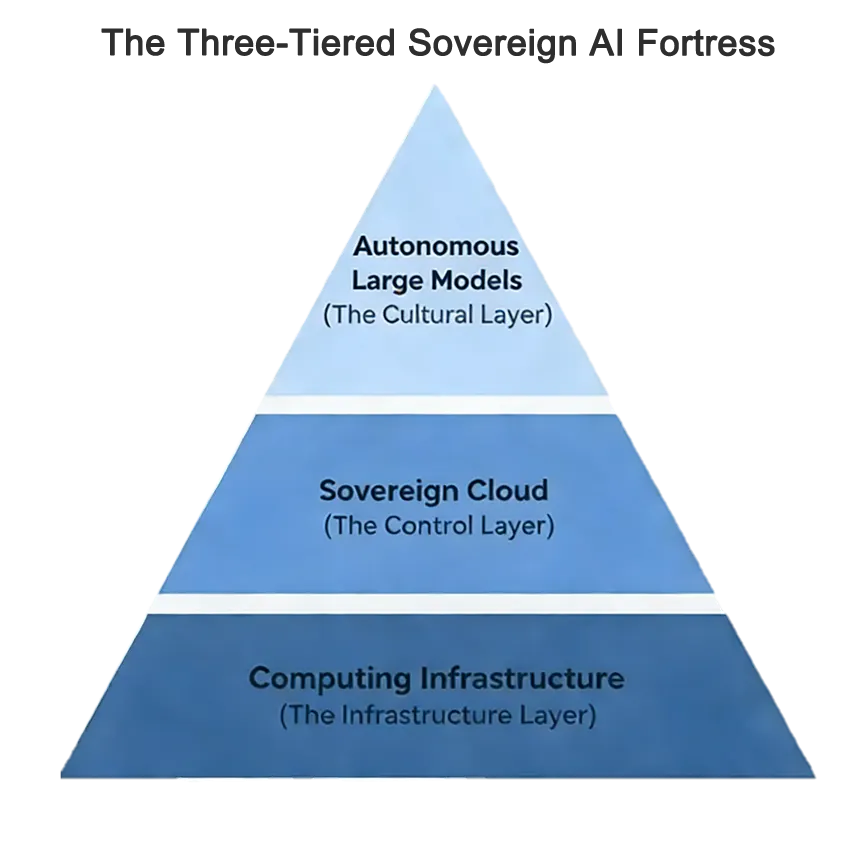
The BRICS countries should develop a three-tiered sovereign AI system. Each tier would serve distinct but complementary functions in ensuring autonomy, interoperability, and collective acceleration among BRICS members.
- The first layer consists of computing infrastructure in the form of data centers and supercomputing networks, which are controlled by the respective countries. This infrastructure can be likened to “land” in the digital age.
- The second layer is the sovereign cloud, which ensures that all critical data is truly owned and controlled by each country in physical and legal terms.
- The third layer comprises autonomous large models, with each country’s model reflecting its own language, culture, and history. Developing a huge AI model grounded in a civilization’s culture is essential for digital sovereignty.
 A major promising development at this point is the upcoming release of DeepSeek-V4 next week (mid-February 2026). This model aims to improve training performance with its multi-head conditional (mHC) architecture and Engram memory modules. This ensures dependable and effective performance, particularly within the resource-constrained sovereign infrastructure commonly found in the Global South. Furthermore, DeepSeek-V4 is expected to significantly enhance programming capabilities, achieving scores near 90% on benchmarks such as HumanEval and surpassing renowned closed-source models like Claude and the GPT series. This development will allow BRICS+ to develop robust, self-sufficient software ecosystems, free from foreign dependence.
2. Creating Flowless Data Corridors for Digital Collaboration
BRICS+ can also set up robust data routes not by ignoring sovereignty, but by digitally encoding it. The goal is to structure these corridors around infrastructural control, geopolitical reciprocity, and economic incentives.
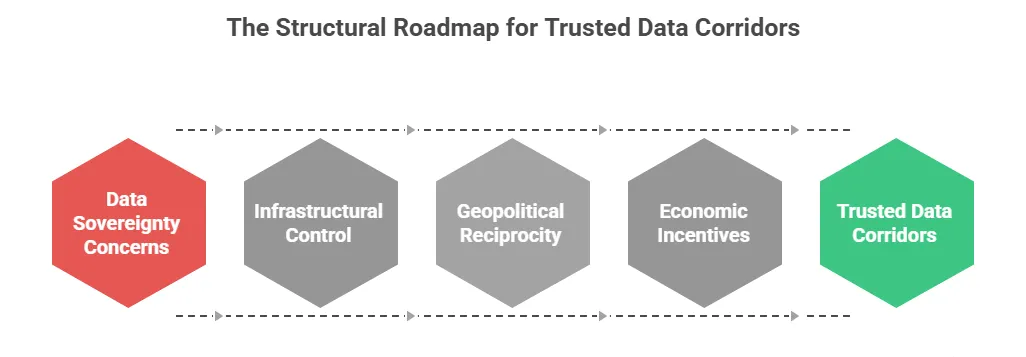
Infrastructural Control BRICS+ should prioritize sovereign-controlled infrastructure like national data centers and edge computing networks to host corridor endpoints, ensuring data never leaves jurisdictional borders without explicit consent. For example, China’s National Data Administration had, by 2025, developed eight national integrated computing hubs (e.g., in Guizhou, Inner Mongolia, Gansu) via the “East Data, West Computing” project—handling substantial national data volumes locally while enabling API-based interconnections. Russia similarly integrated with BRICS partners in 2024-2025 pilots, processing secure cross-border analytics without reliance on Western providers.
Geopolitical Reciprocity BRICS+ corridors must embed mutual recognition treaties that allow each nation to enforce its own data laws, using blockchain for verifiable compliance logs without ceding oversight. India’s Digital Personal Data Protection Act (2023) and Brazil’s Lei Geral de Proteção de Dados (LGPD) constituted pivotal legal instruments underpinning the bilateral confidence frameworks endorsed at the 2025 BRICS Rio Summit. The resultant Data Economy Governance Understanding operationalized a harmonization between transnational data transfer regimes and national jurisdictional prerogatives, thereby constraining the cross-border applicability of the U.S. CLOUD Act via localization-based enforcement. In parallel, the incorporation of South Africa’s POPIA within these pilot regimes facilitates protected health data circulation akin to the Brazil–EU adequacy decision of January 2026—covering an estimated 670 million data subjects—while extending equivalent safeguards across BRICS through a governance model imbued with veto competencies to preclude hegemonic influence over standard-setting.
Economic Incentives Finally, trusted data corridors can foster regional data markets and AI collaborations by enabling secure flows of digital assets like health analytics and logistics data. The establishment of transparent reward and compliance architectures—embodied in tokenized access mechanisms and distributive revenue-sharing schemes—has enabled the commodification of participatory data governance through data trusts. Empirical validation of this model is seen in the BRI digital corridor pilots, where infrastructural integration across nodes stretching from Jakarta to Johannesburg produced measurable efficiency gains, including trade cost reductions of approximately 12%, and generated projections of $1.6 trillion in annualized value creation by 2030. India’s presidency in 2026 signifies a pivotal moment for the establishment of BRICS+ cross-border data corridors. By unifying BRICS+ into a cohesive digital coalition that can establish global standards for sovereign AI and secure data exchange, the alliance mitigates the This strategic positioning ensures that digital integration functions as an instrument to fortify, rather than erode, national sovereignty.


 By WanyuLiao


No comment yet, add your voice below!