
While the world’s superpowers race for dominance in compute power and large-scale models, Brazil is playing a different game. As a key member of the BRICS, Latin America’s largest economy is pioneering a high-stakes national experiment: a “Governance-First” model for artificial intelligence. Instead of building its strategy on a foundation of silicon, Brazil is building it on law, ethics, and social equity. This is a radical bet that seeks to create a new “Southern” template for AI, one that prioritizes human rights over the raw pursuit of innovation.
This article analyzes the three core tensions at the heart of Brazil’s gambit: a profound clash between its legal ambitions and its infrastructural reality; a deep gap between its social equity goals and its on-the-ground market failures; and the resulting strategic imperative to find new multilateral alliances to ensure its model survives.
1. The ‘Governance-First’ Blueprint
Brazil’s experiment began not with a technology, but with a text. The 2021 National AI Strategy (EBIA) formally established the nation’s agenda, but it was the landmark 2024 AI Bill (PL 2338/2023) that gave it teeth. This legislation makes Brazil one of the first countries in the world to enact a comprehensive, binding legal framework for AI.
Critically, the law establishes a risk-based classification system—segmenting AI into “unacceptable,” “high,” and “limited” risk—and enshrines principles of transparency, non-discrimination, and human oversight. Where the EU’s AI Act is largely focused on market regulation, Brazil’s law is explicitly designed to address social problems, such as protecting labor rights and mitigating algorithmic bias, reflecting a distinct “Global South” perspective. This blueprint is Brazil’s opening move: an attempt to shift the global AI conversation from a race for power to a debate about principles.
2. The Model Confronts Reality
The “Governance-First” model is ambitious, but it is being built on fragile foundations. The moment the law was passed, its core tensions were immediately exposed by the realities of the market.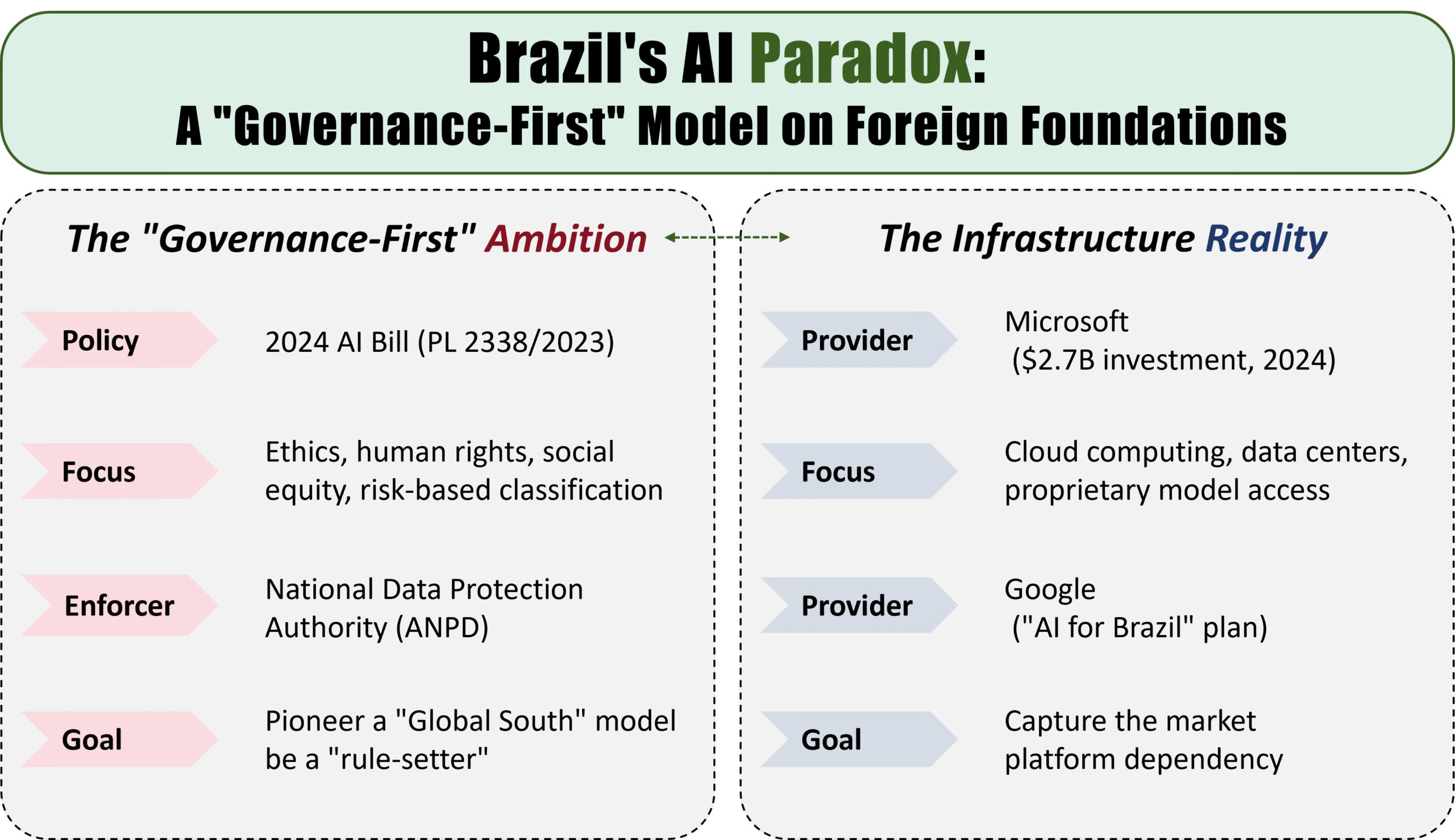
Fig.1 Brazil’s AI Paradox
The Infrastructure Dilemma: Can You Regulate Your Landlord?
Brazil’s digital infrastructure is almost entirely imported. In September 2024, Microsoft announced a massive $2.7 billion investment to expand its cloud computing and AI data centers in the country, followed by Google’s “AI for Brazil” plan.
This flood of foreign capital creates a fundamental conflict: how can Brazil’s National Data Protection Authority (ANPD) genuinely enforce its progressive laws against the very corporations that are its national compute infrastructure? This tension is not theoretical. In 2024, the ANPD was forced to intervene and suspend Meta’s plan to use Brazilian user data for training its generative AI models. This was a clear clash between Brazil’s new rules and a foreign platform’s business model. It raises the central, unresolved question: do Brazil’s laws have any real power when the “on/off” switch is controlled from abroad?
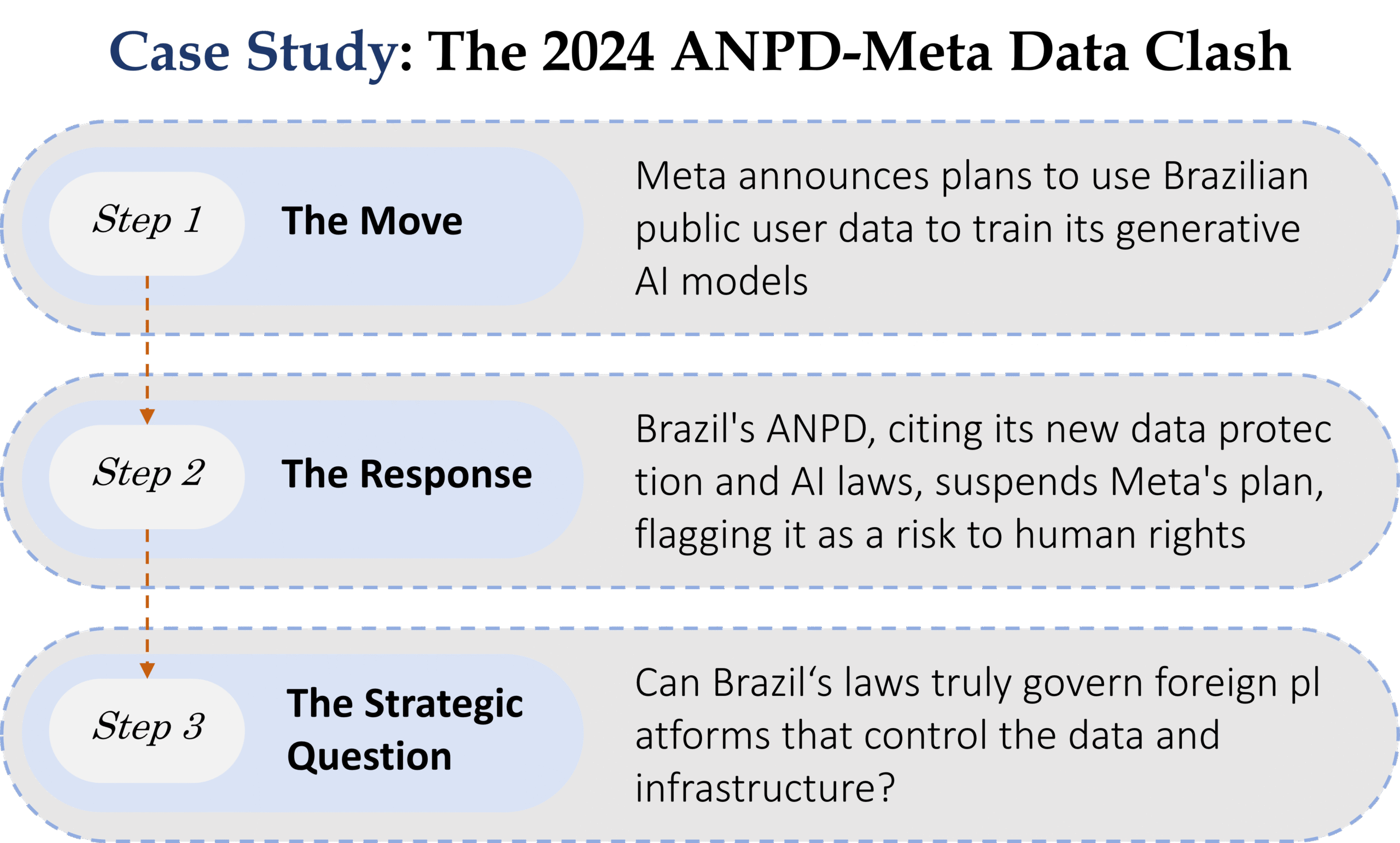
Fig.2 Case Study
The Social Equity Gap: A Tool for Inclusion, or a Driver of Inequality?
The promise of Brazil’s model is using AI for social inclusion. A prime example is in fintech, where startups are using AI-powered WhatsApp services to provide financial support to users in remote, underserved regions.
The peril, however, is that this technology will only widen the country’s severe structural divides. The draft itself notes a critical talent shortage and deep-seated inequalities. Will this new wave of technology actually lift all boats, or will it merely create a small, high-paid AI elite in São Paulo while leaving the rest of the country behind? The government’s “AI Procurement in a Box” plan is a modest attempt to build state capacity, but it is dwarfed by the scale of the challenge.
3. The Multilateral Imperative
Brazil’s “Governance-First” model is too vulnerable to succeed on its own. The tensions are too great, and the dependency on foreign capital and tech is too deep. This reality has created a clear-eyed strategic imperative: if the model is to survive, it must be exported.
This is why the BRICS framework is not just a secondary foreign policy goal for Brazil; it is the primary strategic solution to its domestic AI problem. Brazil cannot become a “rule-setter” if it is the only one playing by its rules.
The BRICS+ collective offers the only viable path to solving the tensions:
- Alternative Capital & Tech: It provides access to alternative capital via the New Development Bank (NDB) and alternative technology partners through bilateral agreements, such as the May 2025 AI Cooperation MOU signed with China.
- Diplomatic Scale: It provides the collective diplomatic weight needed to turn Brazil’s national law into a “Global South” standard.
Brazil’s leadership at the G20 Digital Economy ministerial and the 2025 BRICS Summit in Rio—which produced the landmark “Global AI Governance Leaders’ Statement”—must be seen in this light. This is not just diplomacy. It is a concerted effort to build a coalition of allies, to create a market for its ideas, and to forge a multipolar AI world where its “Governance-First” experiment has a fighting chance to survive.

 By WanyuLiao


No comment yet, add your voice below!