
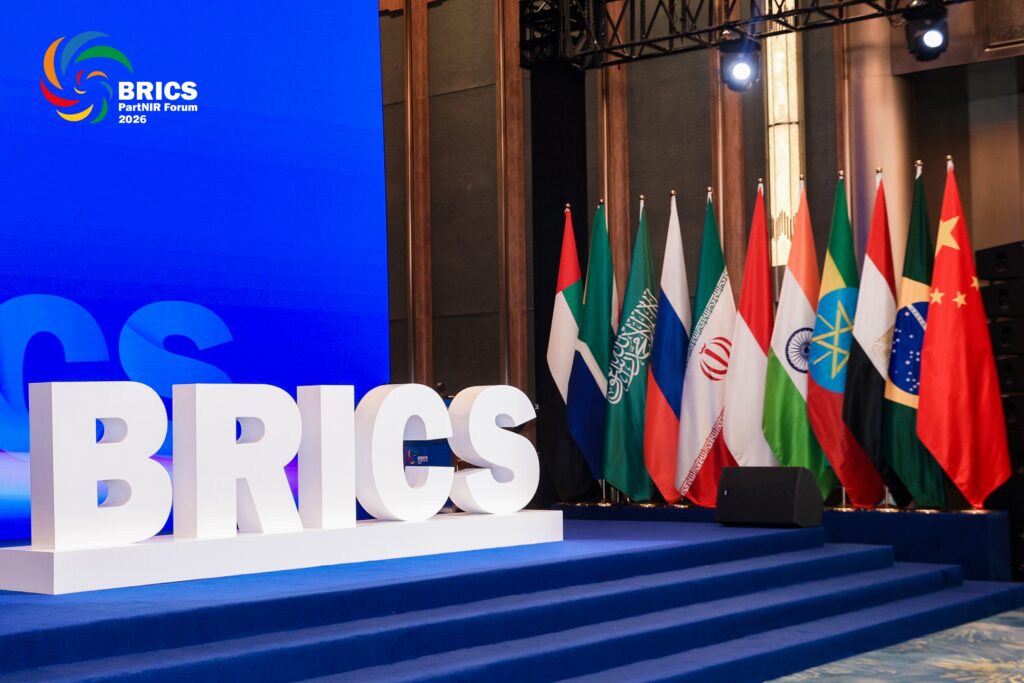
As the Institute for Digital Economy & Artificial Systems (IDEAS), we proudly contribute to BRICS’ mission of fostering economic cooperation and innovation. BRICS, initially coined as “BRIC” by economist Jim O’Neill in 2001, began as a coalition of Brazil, Russia, India, and China. It was formalized in 2009, with South Africa joining in 2010 to form BRICS. Recent expansions in 2024 and 2025 added Egypt, Ethiopia, Iran, UAE, and Indonesia, bringing the total membership to ten. This growth underscores BRICS’ vision of challenging Western-dominated institutions and promoting a multipolar global order.
Impacts and Membership
BRICS now represents over 41% of global GDP and half the world’s population. It has significantly influenced global trade, financial systems, and policy coordination. The New Development Bank (NDB), headquartered in Shanghai, has approved $35 billion for infrastructure projects and established a $100 billion contingency fund to enhance financial stability. Beyond its full members, nine partner nations—including Algeria, Malaysia, and Nigeria—are engaging with BRICS+, signaling its expanding influence.

China’s Role and Institutions
China plays a pivotal role in BRICS’ success. It spearheaded initiatives like the NDB and “BRICS+” expansion while contributing $41 billion to contingency funds. In Xiamen, the BRICS Partnership on New Industrial Revolution (PartNIR) Innovation Center drives industrial collaboration. Notably, efforts like BRICS Pay aim to reduce reliance on the US dollar by fostering local-currency trade.
IDEAS: Driving Innovation Across BRICS+
At IDEAS, based in Xiamen’s China-BRICS Science & Innovation Incubation Park, we act as a catalyst for sustainable growth across BRICS+. Leveraging AI and digital technologies, we focus on policy coordination, academic-industry collaboration, and talent cultivation. Our initiatives have fostered cross-border partnerships worth billions while advancing digital economy integration among member states. Together with BRICS+, we are shaping an inclusive future driven by innovation.

 By WanyuLiao


No comment yet, add your voice below!