
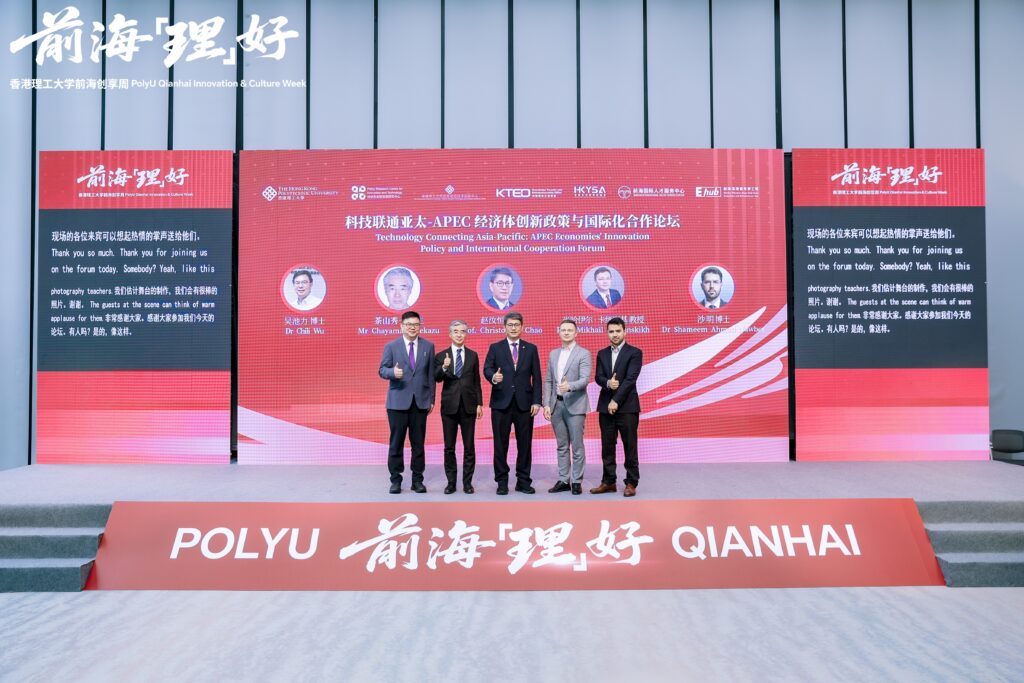
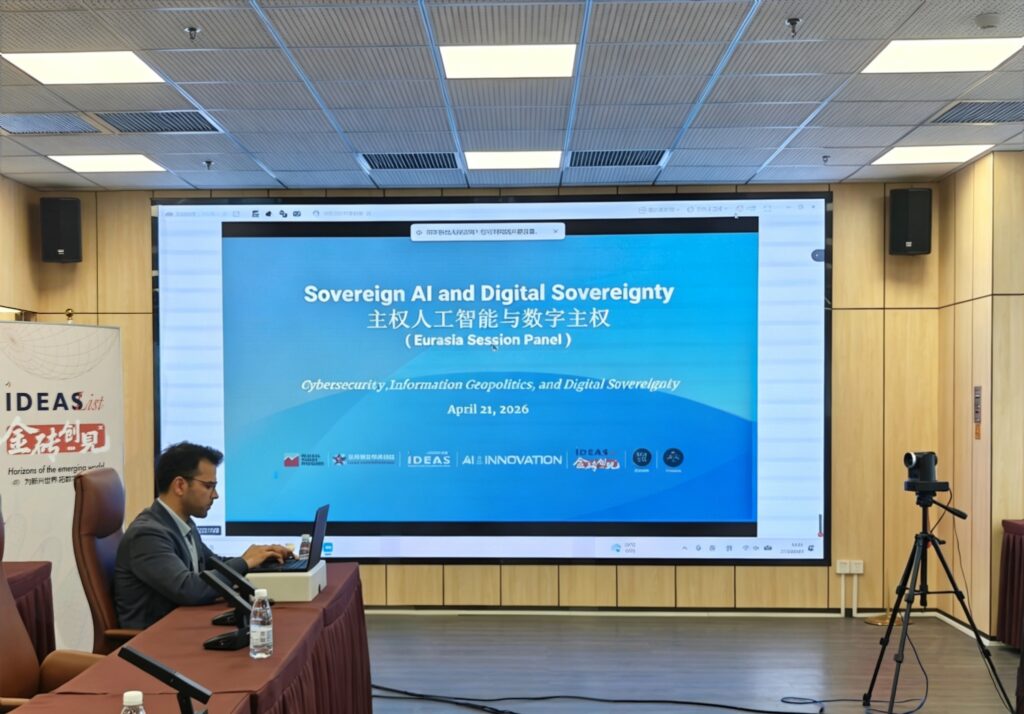
Dr. Shameem Ahmad Nawber is Deputy Director of IDEAS-BRICS and Associate Editor of AI & Innovation (AI²). This commentary is based on a seminar delivered at Tsinghua University on April 20, 2026.
The standard debate about world order tends to get stuck in the same rut—unipolar or multipolar, American dominance or its decline. But that framing is too blunt to capture what is actually happening. Amitav Acharya’s concept of a “multiplex order” offers something more useful: a world where power is not simply held but performed—through the capacity to move goods, mobilize capital, and maintain connectivity across an increasingly fractured global system. The Global South, in this reading, is not a passive recipient of decisions made elsewhere. It is an active, if uneven, force reshaping the rules of engagement from the inside.
- From the Illusion of Prosperity to Reality
On paper, 2025 looked like a recovery. Global trade reached a historic high of 35 trillion US dollars, up 7.5% year on year—the kind of number that makes for confident headlines. But the foundations were thin. Much of that growth was driven not by genuine demand but by a rush to stockpile ahead of tariffs and a narrow boom in AI-related hardware. Strip those out, and the picture looks considerably less robust.
2026 confirmed the suspicion. The WTO revised its forecast for global merchandise trade growth down to 0.5%—barely a rounding error in historical terms. Tariff threats reaching as high as 100% on allies, creeping restrictions on digital services, and the slow erosion of investment confidence—these were not temporary shocks but the delayed, compounding costs of years of policy aggression finally arriving at the door.
- The Middle East Crisis: A Trigger for Multiple Shocks
What broke out in late February 2026 was not simply a regional conflict. The US-Israel-Iran war set off a sequence of disruptions—each one feeding the next—that exposed just how tightly the global economy is still wired together and how little redundancy has been built into it. The IEA called it the largest supply disruption in the history of the global oil market. The comparison to 1973 is not hyperbole.
The Strait of Hormuz closure pulled 8 to 10 million barrels of crude per day from the market. Brent crude broke 120 dollars a barrel, up more than 40%. Alternative pipeline routes, long discussed as contingency options, proved nowhere near adequate. Global LNG supply dropped by 12.8 million tons annually. Asian spot prices nearly doubled. Maritime war risk insurance premiums climbed 1,000%. The energy system, in short, had no slack left to absorb a shock of this magnitude.
The food dimension was slower to surface but no less severe. Natural gas feeds fertilizer production—nitrogen synthesis, above all—and the Middle East supplies roughly half of the world’s seaborne urea and sulfur. Once the blockade choked that flow, the consequences moved quickly. Urea prices jumped 46% in a single month. Ton—nearly double prewar levels. Agriculture operates on fixed seasonal windows. Miss the spring planting cycle and there is no correcting it later. The World Food Programme estimated that 45 million more people could be pushed into severe famine. For import-dependent developing countries, this was not an abstract risk — it was existential.
- Sanctions, “Unilateral Coercive Measures,” and Financial Bifurcation
There is a language divide worth paying attention to here. What Washington calls sanctions enforcement, much of the Global South—and Chinese academic discourse in particular—calls “unilateral coercive measures” and the abuse of “long-arm jurisdiction.” That distinction matters, because it signals something deeper than disagreement over a specific policy. It reflects a growing conviction that the dollar-based financial system has been weaponized, and that dependence on it has become a structural vulnerability.
De-dollarization, in this context, is no longer a slogan. It is a risk management decision. The expanded BRICS group is building out BRICS Pay and BRICS Bridge as alternatives to SWIFT. The mBridge platform is constructing a multi-CBDC settlement layer on blockchain infrastructure—and it is already moving real volume. Processing has reached roughly 55 billion dollars equivalent, with around 95% running through the digital yuan. Meanwhile, compliant Western banks, squeezed by the compliance costs of sanctions enforcement, are quietly accelerating their own retreat—a process of de-risking that, paradoxically, is doing as much to fracture the financial architecture as any deliberate act of the Global South.
- Fragmented Academic Frameworks: “Great Game” and “Doom Loop”
Two pieces of recent scholarship help explain why fragmentation, once it starts, is so difficult to stop.
Clayton, Maggiori, and Schreger’s March 2026 paper The Great Game: A Model of Geoeconomic Competition identifies a structural trap at the heart of the current order. Globalization works precisely because of economies of scale—but those same economies of scale make building alternative supply chains ruinously expensive. Dominant powers know this. The lack of substitutability is not a side effect of globalization; it is the mechanism through which coercion operates.
The BIS frames the problem differently but arrives at a similar place. Its concept of a “fragmentation doom loop” describes how uncoordinated protectionism, country by country, progressively dismantles the integrated system that everyone nominally wants to preserve—at an estimated welfare cost of 2% to 7% of global GDP. Neither paper offers a clean exit. What they share is a sober recognition that the logic of fragmentation, once activated, tends to be self-reinforcing.
Into this environment, a new category of actor has emerged: the “Connector Country.” Mexico, Vietnam, Poland, Morocco, India—nations positioned at the seams between competing blocs, absorbing FDI from both sides and threading supply chains through the gaps. The organizing principle of global production is shifting from cost efficiency to risk distribution. Supply chains are not decoupling so much as rerouting—lengthening, branching, becoming more complex and more fragile in new ways.
- Climate-Trade Collision and Institutional Paralysis
The EU’s Carbon Border Adjustment Mechanism moved into full operation in 2026, and the friction it has generated is real. A WTO panel ruling that US green subsidies under the IRA violate trade rules has added another layer of institutional tension. What makes this moment particularly difficult is that the WTO Appellate Body—the mechanism that might otherwise arbitrate these disputes—remains paralyzed. Adjudicator appointments have been blocked for years. The institution exists. The capacity to resolve conflicts through it, for now, does not.
- Toward a “Community with a Shared Future for Mankind”
The phrase “community with a shared future for mankind” carries specific weight in Chinese political discourse, but its substantive content maps closely onto what Acharya describes in multiplex order theory: a world where legitimacy is plural, where middle powers have genuine agency, and where the accumulated pressure of shared problems—climate, food, and financial instability—eventually compels cooperative responses that no single hegemon can deliver alone.
None of this is inevitable. Fragmentation has its own momentum. But so does interdependence. The question is which logic proves more durable—and which actors have the imagination and the institutional creativity to build something in the space between confrontation and collapse.

Q&A
Q1: Can the “Connector Country” model become a long-term strategy?
I think it can stay relevant for quite a while — probably for the next ten years, at least. But I would not call it a clean or stable long-term strategy. There are real tensions inside it. Take India as an example: the headline numbers look very strong, but if you look more closely at low-income groups or at climate and environmental pressure, the picture becomes more complicated. So yes, it creates opportunities, but countries also have to think about fairness, sustainability, and how much cost they are willing to absorb. For companies, this is less about making one big long-term bet and more about adjusting to risk as it shifts.
Q2: BRICS payment systems are still immature, and member interests diverge sharply. How does coordination actually happen under those conditions?
It happens slowly, and honestly, that is normal. I do not think de-dollarization is really an ideological project. It is becoming a practical response to risk. Countries are looking for ways to reduce dependence on a system that can be used against them. The UAE joining mBridge is a positive example—this is not a country trying to make a political statement against the West. It is making a practical choice. Over time, as these systems become more transparent and more usable, more countries will likely join in. I would expect a more stable alternative settlement ecosystem to take shape in about five years, though it will not happen overnight.

 By WanyuLiao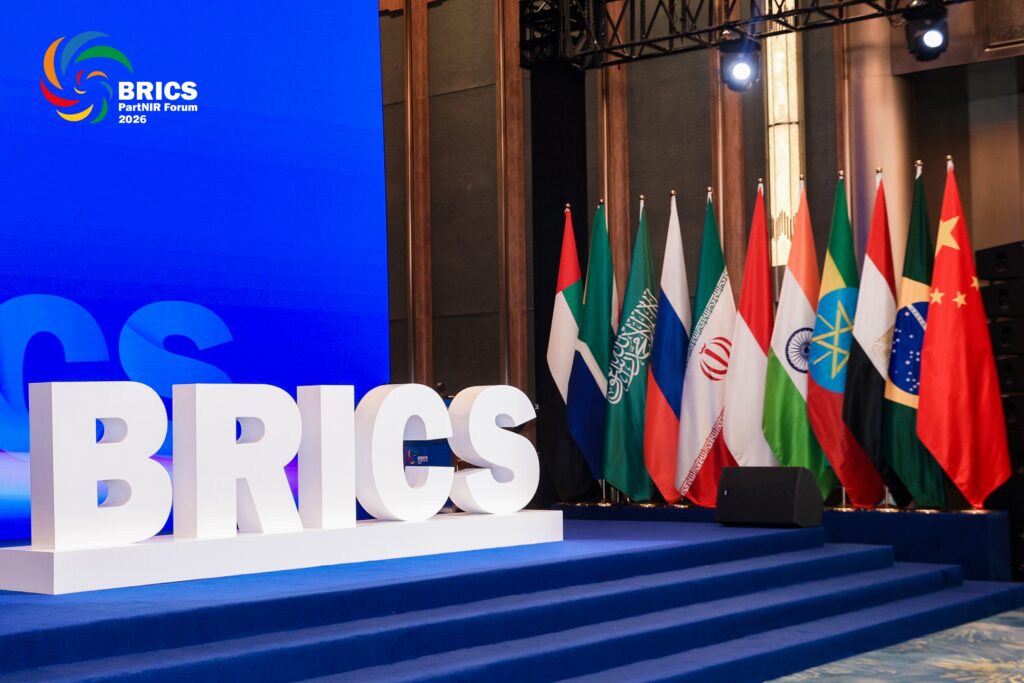
No comment yet, add your voice below!