
An IDEAS-BRICS institutional commentary on the BRICS Partnership Forum on the New Industrial Revolution — Xiamen, 27–28 May 2026.
1. Introduction
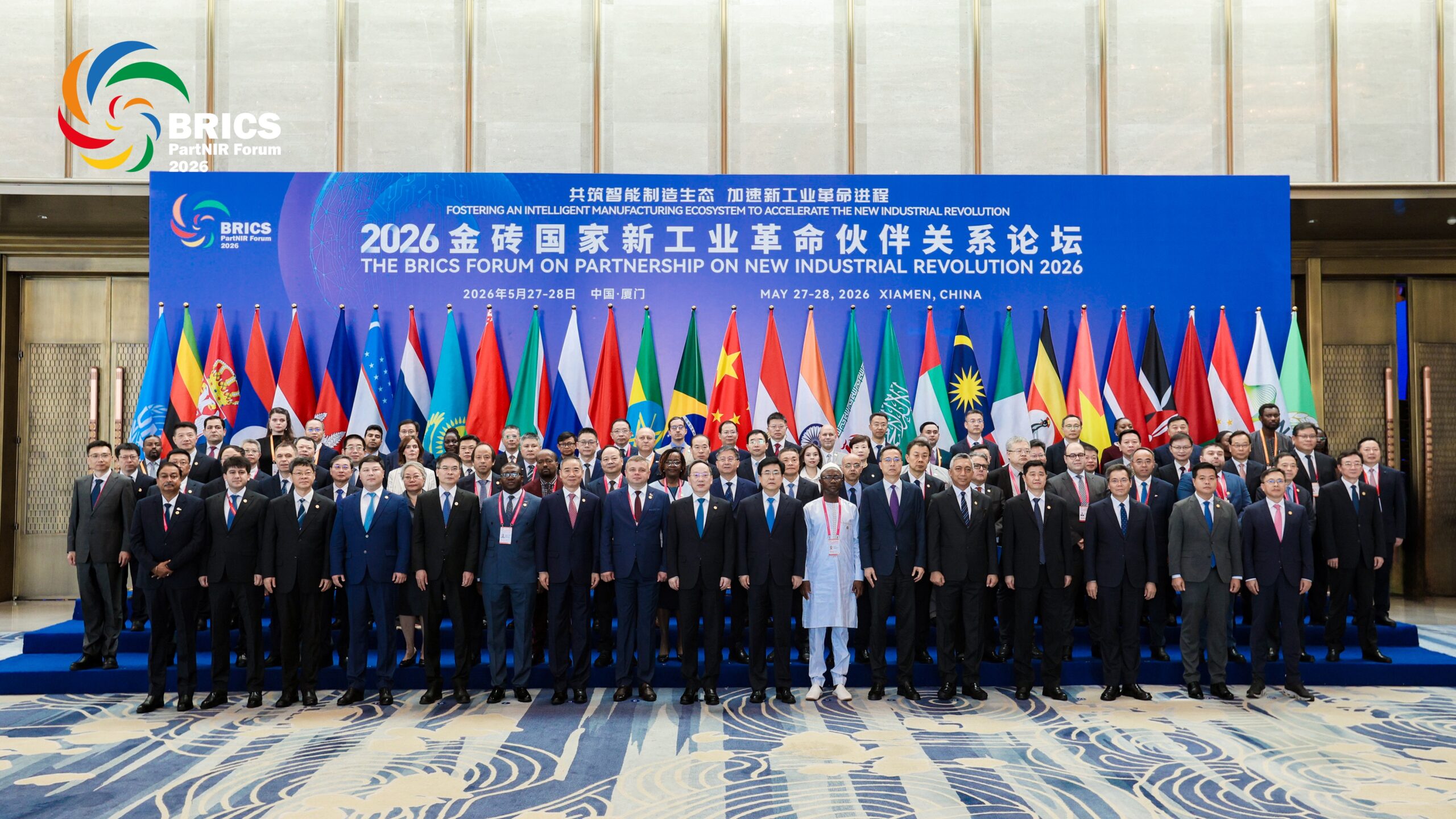
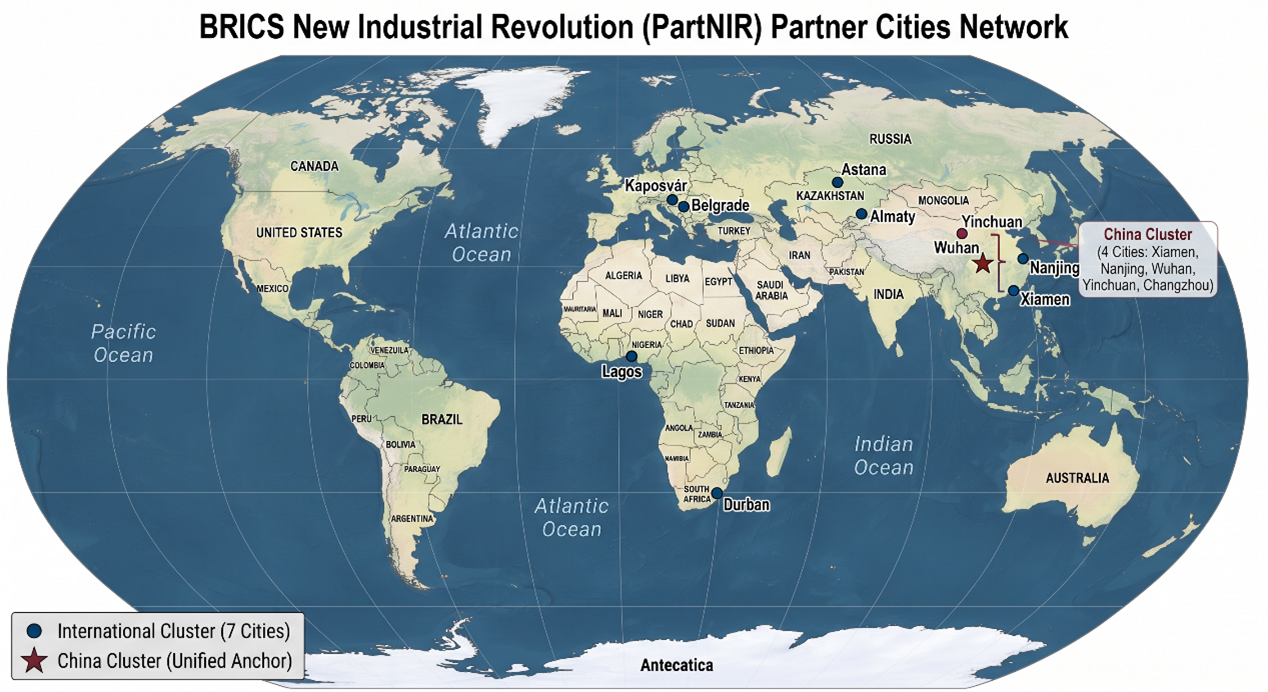
The 2026 BRICS Digital Economy Cooperation Week — held in Xiamen on 27–28 May and anchored by the BRICS Partnership Forum on the New Industrial Revolution — closed with a sharper, more institutional agenda than any of its predecessors. Convening delegations from 27 BRICS member, partner and observer countries together with the New Development Bank and UNIDO, the Week translated five years of declaratory cooperation into three operational outcomes: an outward-facing posture on standards (the English edition of China’s Recommended Smart Manufacturing Standards, released by the International Smart Manufacturing Alliance); a city-level cooperation channel (the New Industrial Revolution Partner Cities Network, spanning eleven cities from Durban and Lagos to Belgrade, Almaty, Astana, Kaposvár, Xiamen, Nanjing, Wuhan, Yinchuan and Changzhou); and a curated portfolio of cross-border industrial projects (the 2026 BRICS Industrial Cooperation Case Studies, released by the China Centre for BRICS Industrial Capabilities).
Attribution: people.cn
For the Institute for Digital Economy and Artificial Systems (IDEAS-BRICS), the Week was both an observation point and a participation site. Across the Main Forum and the four sub-forums — on tiered smart-factory development, the digital transformation of clean-energy products, industrial-intelligence science and technology innovation, and industrial software — the through-line was structural: the bloc is moving from generic “cooperation” towards differentiated, mechanism-based collaboration, in which standards, scenarios and project pipelines carry the weight. Vice Minister Xin Guobin‘s three proposals at the Main Forum — joint smart-factory construction, system-solution sharing, and mutual recognition of standards — read less as new ideas than as a consolidation of where BRICS industrial cooperation has, in practice, already arrived. The opening ceremony, addressed by MIIT Minister Li Lecheng, Fujian Governor Zhao Long, Belarusian Industry Minister Andrei Kuznetsov, NDB Vice President Rajiv Ranjan, UNIDO Deputy Director-General Zou Ciyong, and ICBC Chairman Liao Lin, signalled this consolidation across all four arenas at once — government, industry, multilateral finance and standards-setting.
Building on these foundations, IDEAS-BRICS’s work in the coming period focuses on deepening the project pipelines unveiled at the Forum, supporting the research underpinnings of the Partner Cities Network, and contributing to the alignment of standards, scenarios and finance across the bloc’s smart-manufacturing ecosystem. The sections that follow trace these directions — beginning with the global backdrop against which the Week’s outcomes acquire their full significance.
2. The Global Industrial Intelligence Backdrop
Industrial intelligence is now the constitutive terrain of the new industrial revolution. It encompasses industrial AI, smart factories, industrial robots, digital twins and the Industrial Internet — a stack that has moved from pilot deployments to system-scale infrastructure in under a decade. Market sizing reflects that shift: the global Industry 4.0 market is projected to grow from roughly US$149 billion in 2025 to US$1.2 trillion by 2035, at a compound annual rate of around 24%, while the industrial-AI segment alone is forecast by Grand View Research to expand from US$5.3 billion in 2024 to US$47.9 billion by 2030 (CAGR ≈ 46.5%).
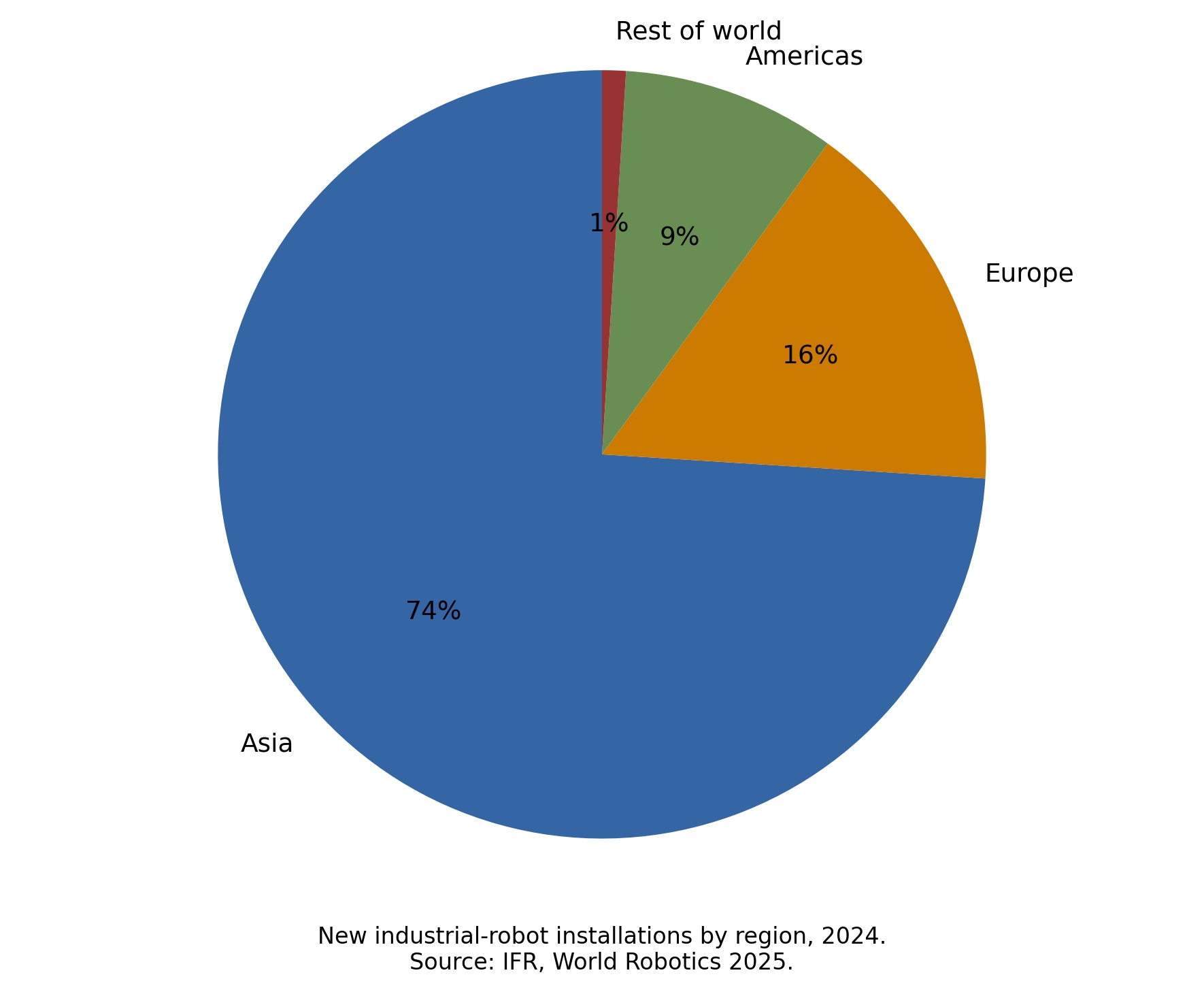
The underlying structure of capacity is more revealing than the totals. North America retains its lead in the foundational layers — industrial-AI algorithms, industrial software, and the semiconductor base — while Europe continues to set the pace on standards and frameworks, most visibly through Germany’s Industry 4.0 architecture. The decisive shift of the past five years is geographic. According to the International Federation of Robotics’ World Robotics 2025, Asia accounted for 74% of new industrial-robot installations worldwide in 2024, against 16% for Europe and 9% for the Americas. China, with the world’s largest manufacturing system and the deepest stock of industrial-internet application scenarios, has become the single most dynamic market for the implementation of industrial-intelligence technologies — a position reaffirmed across the opening session of the Xiamen Forum and reflected in MIIT industrial-policy reporting.
For IDEAS-BRICS, the composition behind these totals matters more than the totals themselves. Application volume, demonstration-scenario density and manufacturing-system depth — the conditions under which industrial intelligence becomes operational at scale — are now most heavily concentrated in Asia, and across the wider Global South alongside it. That is the operational theatre of BRICS industrial cooperation, and it is the composition against which the Xiamen Week’s outcomes acquire their full institutional significance.
3. Recent Progress in BRICS Digital-Economy and Industrial-Intelligence Cooperation
The digital economy has moved, over the past five years, from a declaratory commitment to a working pillar of the BRICS Partnership on the New Industrial Revolution. A dedicated BRICS working group on the digital economy, supported by successive cooperation frameworks — including the BRICS Digital Economy Partnership Framework — has clarified the operational terrain through which the bloc’s policy alignment is being translated into shared scenarios for industrial intelligence, smart manufacturing and green industrial upgrading: digital connectivity, cybersecurity, capacity-building, and regulatory coordination. China has built out a parallel architecture of industrial-cooperation platforms and think-tank channels that now anchor much of this work; the BRICS PartNIR Innovation Center in Xiamen and the Institute for Digital Economy and Artificial Systems (IDEAS-BRICS) are two of its institutional pillars.
The Week’s clean-energy track captured the practical edge of this trajectory. The 2026 BRICS Industrial Innovation Competition convened 1,428 entries from eight countries and regions across five tracks — artificial intelligence, green industry, low-altitude equipment, energy electronics, and wind-power equipment. The first prize in the green-industry category went to Jilin Jiapeng Group’s technology for full-quantity in-situ recycling of asphalt pavement — a project that achieves 100% reuse of old asphalt materials with sulphur-dioxide and nitrogen-oxide emissions held well below national standards. Winning entries enter the BRICS Industrial Innovation Cooperation Project Database and are prioritised for incubation and investment-matchmaking through the BRICS PartNIR Innovation Base.
The shape of these winning projects is itself diagnostic of where BRICS digital-economy cooperation is gaining traction. The competition’s portfolio clusters around green industry, circular materials, low-carbon smart manufacturing and new-material substitution — domains in which industrial intelligence meets the green-transformation agendas embedded in member-country policy and the livelihood-industry base on which much of the bloc’s economic activity rests. For IDEAS-BRICS, this is the substantive content of South–South cooperation in smart manufacturing: an industrial-intelligence agenda oriented to applicable, distributed, ecosystem-level deployment, anchored in the policy priorities of the member countries themselves.
4. China’s Industrial-Internet Leadership and BRICS Partner Engagement
China’s industrial-internet capacity is the substrate against which much of the Forum’s cooperation agenda was set. As of early 2026, MIIT counts more than 340 influential industrial-internet platforms connecting upwards of 100 million units of industrial equipment, with an action plan released in January 2026 targeting over 450 platforms and 120 million connected devices by 2028. The country’s smart-factory gradient cultivation programme — co-administered by MIIT and five other state agencies across four tiers (basic, advanced, excellence, pioneer) — has now produced more than 7,000 advanced-level facilities, with the excellence cohort reporting average gains of 22.3% in production efficiency and a 20.4% reduction in carbon emissions. The 5G+ Industrial Internet “512 Project” carries the network layer forward, targeting 10,000 5G factories and 20 integrated pilot cities by 2027.
The Forum highlighted several pipelines through which that transfer is already underway. The marquee case is CATL’s US$6 billion Indonesia Battery Integration Project — spanning nickel mining in North Maluku, battery materials, manufacturing at Karawang in West Java, and recycling — with first-phase lithium-ion capacity of 6.9 GWh expected on-line by the end of 2026. The project applies CATL’s Lighthouse Factory and Extreme Manufacturing protocols at the manufacturing node, providing a concrete reference case for technology and process transfer under partner-country policy frameworks rather than as a standalone export contract.
Parallel tracks were visible across the Week. ApexBrasil’s continued engagement with the BRICS PartNIR Innovation Center — Brazilian commercial delegations into Xiamen, matchmaking events with Chinese partners across stone, machinery and consumer-goods sectors — is incrementally building a Latin-American node into the Partnership’s project pipeline. South Africa’s industrial-AI agenda is being scaffolded by its own draft National AI Policy (2026), which proposes a National AI Commission and a sector-specific regulatory architecture; that domestic anchor is what makes BRICS technical cooperation on industrial AI tractable on the African side rather than purely advisory.
For IDEAS-BRICS, the point is structural. China’s industrial-internet build-out is not, in itself, what the Partnership is about; it is the substrate on which member-country cooperation becomes operational — in the form of supply-chain projects (Indonesia), commercial-engagement channels (Brazil) and domestic policy frameworks that absorb shared technology (South Africa). The Partnership’s work in the coming period is to deepen the conversion rate from substrate to project: turning platform capacity into mutual standards recognition, training pipelines and joint R&D across the bloc.
5. Xiamen Outcomes and IDEAS-BRICS’s Forward Agenda
The Week’s operational ledger consolidated a pattern already visible in §§1 and 4. The China Centre for BRICS Industrial Capabilities and the BRICS PartNIR Innovation Center jointly catalogued 138 cross-border industrial cooperation projects in the 2026 BRICS Industrial Cooperation Case Studies, with cumulative investment now exceeding 62 billion yuan — the formal vehicle through which the project pipeline becomes visible to partner-country ministries, multilateral lenders and the matchmaking work of the Innovation Base. Alongside it, the Week’s side events produced concrete bilateral agreements — including Xiangyu Group’s commercial commitments with Indonesian counterparts and the Shulian–RUDN cooperation track on industrial training — that give the broader Partner Cities Network its first operational anchors. The bloc’s trade composition reflects the same direction of travel: between January and April 2026, China’s trade with BRICS partners grew at a pace materially above the country’s overall trade growth, with digital and industrial categories disproportionately concentrated in that gap.
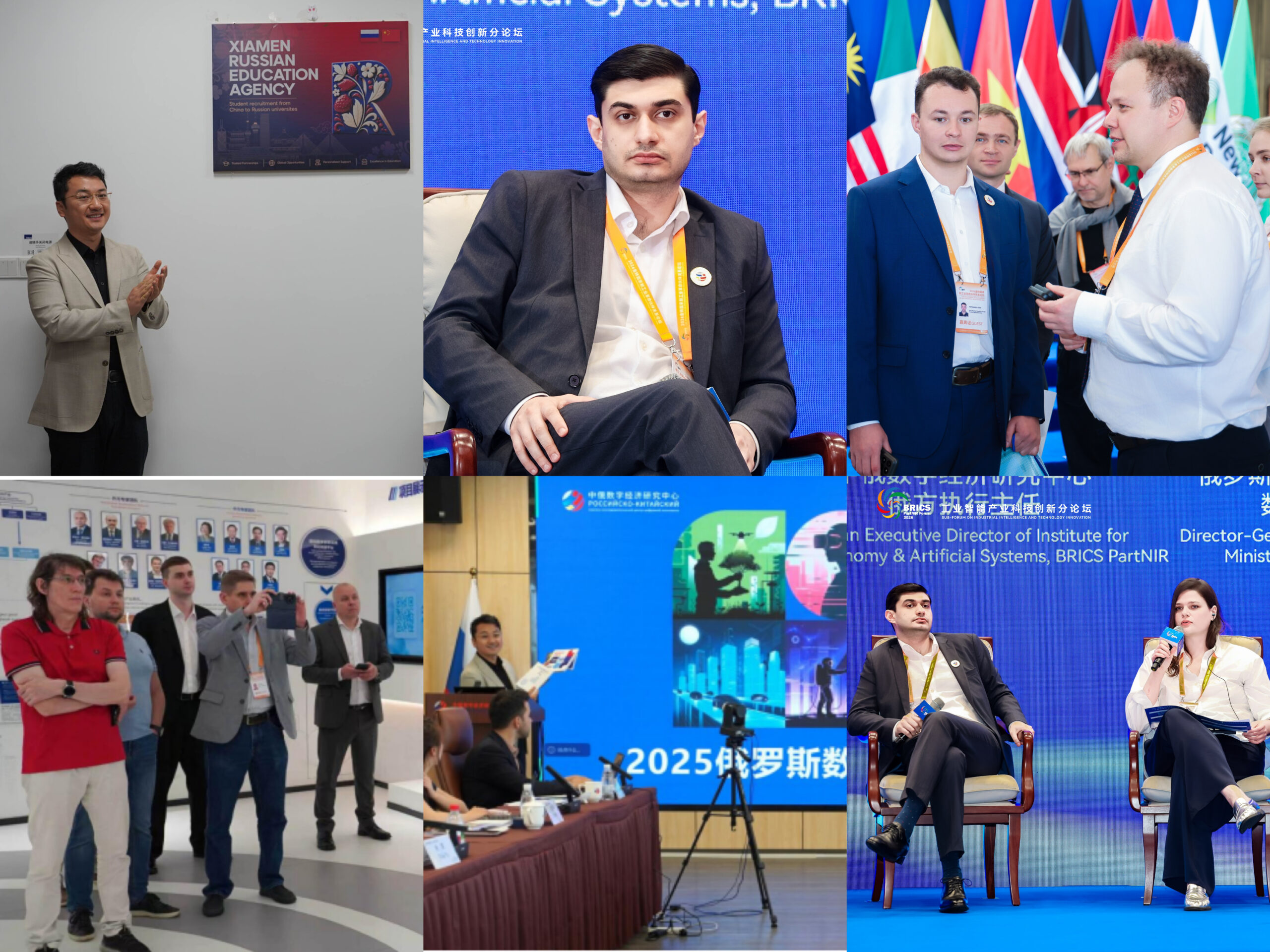
IDEAS-BRICS‘s own participation across the Week was distributed across several institutional points. Yu Xiao, Director and Deputy Secretary-General, and Mekhri Aliev, Board Member, set out the Institute’s working agenda on cross-border industrial-data cooperation, standards harmonisation and joint smart-manufacturing scenarios across the bloc. One of the Week’s co-hosted side engagements — a digital-economy seminar with Russian counterparts, at which Russia’s Digital Economy White Paper was released in a Chinese-language edition — was among several tracks through which the Institute’s research agenda is being built out, alongside the widening of the Zhongguancun Alliance representative office’s institutional reach into the Partnership’s project pipeline.
What the Week leaves behind, read against the institutional architecture mapped in §3 and the substrate-to-project conversion question raised in §4, is a defined work programme rather than an open horizon. IDEAS-BRICS’s focus in the coming period is to convert the deliverables of Xiamen into durable research, training and standards work: deepening the case-study volume from a one-off publication into a continuously updated BRICS industrial-cooperation case repository; supporting the research underpinnings of the Partner Cities Network with comparative industrial-policy work across the eleven cities; developing referenceable bilateral cooperation models that can be extended across the bloc’s partner-country pairings; and contributing the Institute’s analytical work to the alignment of standards, scenarios and finance across the bloc’s smart-manufacturing ecosystem. The Partnership’s ambition has, since the 2018 Johannesburg Summit, been to make the new industrial revolution something the bloc co-shapes rather than something it absorbs. The Xiamen Week’s outcomes — and the institutional work now downstream of them — are the form in which that ambition is becoming tractable.

 By WanyuLiao
No comment yet, add your voice below!