
Theme Collection: Sovereign AI and Digital Sovereignty
Submission deadline
Thursday, 31 December 2026
The rapid advancement of artificial intelligence has intensified debates over digital sovereignty worldwide. As AI systems increasingly shape economic activities, political discourse, and social interactions, the ability to develop indigenous AI capabilities and control digital infrastructure becomes essential to national autonomy. The emergence of sovereign large language models (LLMs), compute geopolitics driven by chip export controls, and digital public infrastructure (DPI) initiatives signal a fundamental shift: nations can no longer treat AI and digital technologies as neutral tools, but must strategically build technological alternatives to ensure self-determination.
Many nations face structural predicaments in achieving digital sovereignty. First, they exhibit high dependence on foreign digital infrastructure, from cloud services to AI platforms—a vulnerability starkly exposed by recent AWS and Cloudflare outages that disrupted services across continents. Second, bilateral trade agreements increasingly embed digital provisions that constrain policy space, as seen in the US-Malaysia agreement’s restrictions on data localization and digital services taxation. Third, sanctions and technology export controls have created divergent pathways, forcing some nations like Russia into accelerated self-reliance while others struggle with systematic capability deficits—countries that once possessed promising indigenous technology industries saw these capacities eroded, and capital barriers to building independent AI ecosystems have become nearly insurmountable.
This Theme Collection examines how different nations experience and respond to these challenges. It brings together scholars and practitioners from Africa, Latin America, South Asia, Southeast Asia, and Russia to analyze the structural constraints on digital sovereignty, the contested role of open-source AI as a pathway to autonomy, and the varied national responses to external pressures. Each contribution offers unique theoretical perspectives—from geopolitical analysis and historical political economy to international relations theory—while grounding arguments in concrete national experiences. The collection maintains a realistic assessment of both opportunities and limitations, recognizing that policy sophistication often outpaces implementation capacity, and that technological alternatives face formidable structural barriers. By establishing sovereign AI and digital sovereignty as legitimate fields of inquiry, this collection aims to provide critical analysis and evidence-based policy recommendations for navigating an increasingly contested digital landscape.
Topics for this call for papers include but are not restricted to:
·Structural predicaments of digital sovereignty and pathways toward technological autonomy
·Open-source AI and sovereign infrastructure: opportunities and limits for the Global South
·The Digital Sovereignty Index: an assessment framework and AI-driven methodology
·The new digital scramble for Africa: trade agreements, infrastructure vulnerabilities, and the call for a Digital Bandung
·South Africa’s digital sovereignty: G20 agenda, structural constraints, and cautious prospects
·The “poison pill” and beyond: Malaysia’s digital sovereignty after the US trade agreement
·Breaking the stranglehold: how China is challenging US technological hegemony and reshaping the global order.
·Russia’s digital sovereignty under sanctions: from defensive measures to proactive construction.
Guest Editors
Prof. Elena Zinovieva MGIMO University Russia
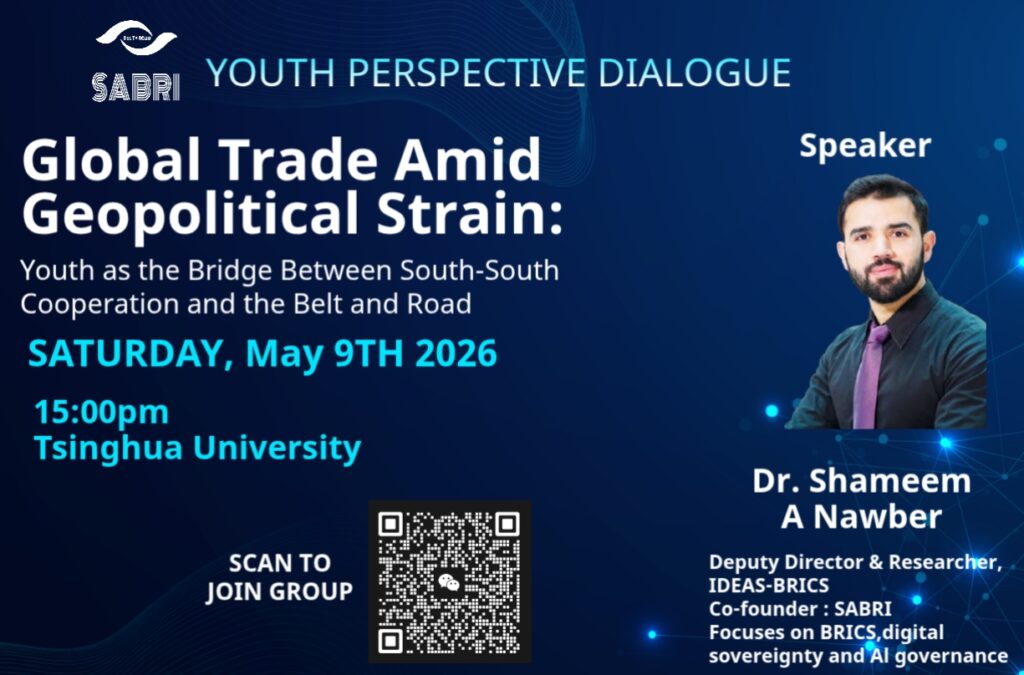
Dr. Shameem Nawber IDEAS-BRICS China
Mr. Jie Xiong Global South Academic Forum China
https://onlinelibrary.wiley.com/journal/30673941

 By WanyuLiao

No comment yet, add your voice below!